Ultrathin SBF-SEM Sectioning Consistency & Image Quality
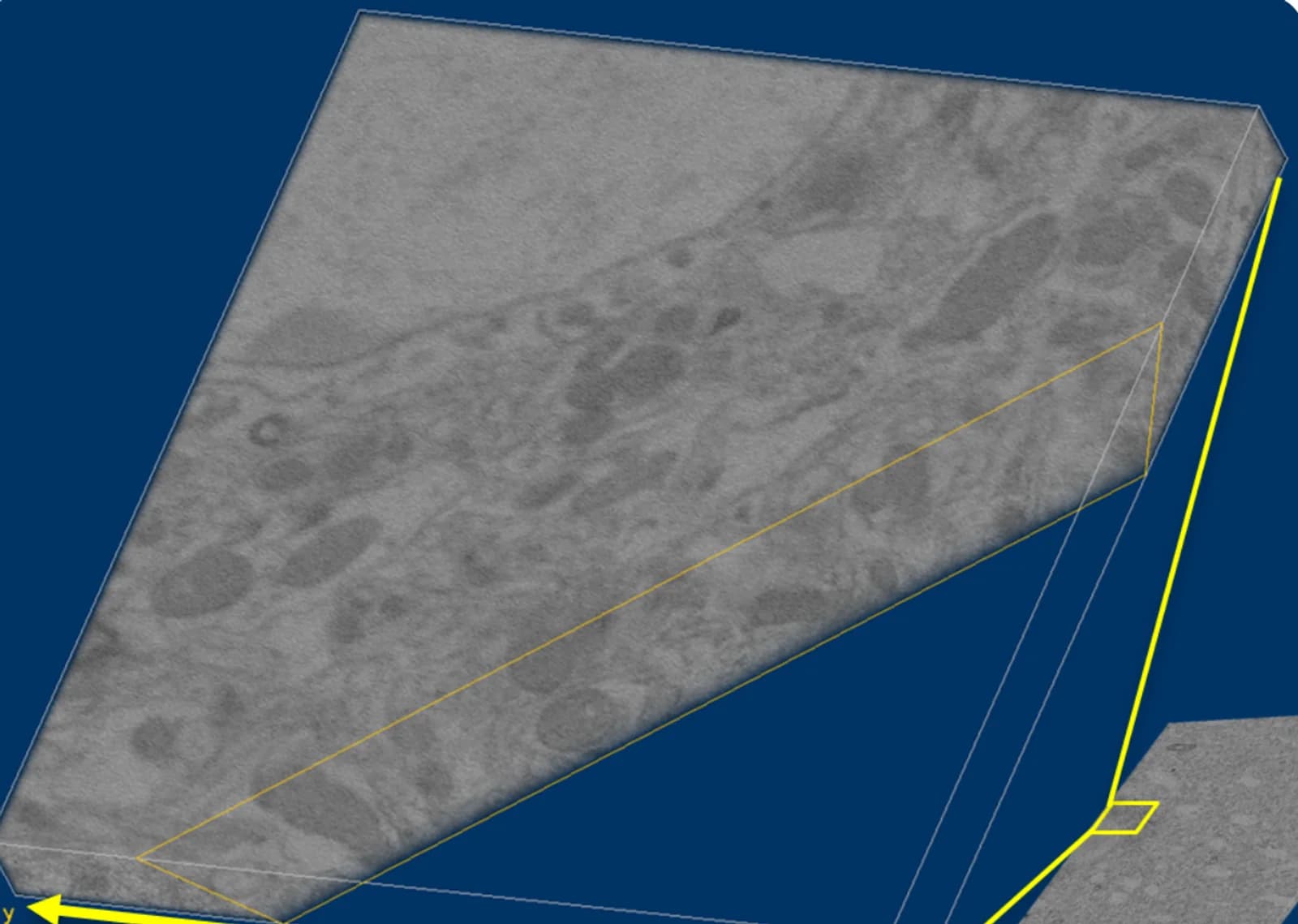
ConnectomX Application Note · Quantitative validation of the Katana microtome and Kensho BSE detector
Abstract
In serial block-face SEM (SBF-SEM), the uniformity of every cut sets the z-resolution and reconstruction fidelity of the whole volume. We quantitatively assessed the cutting consistency and image quality of the ConnectomX Katana microtome and the Kensho backscattered-electron (BSE) detector across nine acquisitions of heavy-metal-stained mouse brain, spanning z-steps from 8 to 80 nm and a range of doses and line-accumulation settings. The headline results are summarised below; full methods, statistics and metric definitions are given in the accompanying paper.
Methods
Preparation & acquisition. Mouse brain tissue was prepared with a heavy-metal en bloc staining protocol. Block-face images were acquired at high vacuum using the Kensho BSE detector, with all sectioning performed by the Katana microtome at 0.05 mm/s (datasets A–G at 1.3 kV / 80 pA; H–I at 2 kV / 100 pA).
Data analysis. A suite of complementary metrics was used to separate genuine cutting variation from imaging artefacts:
- Inter-frame difference (NMAD): a normalised frame-to-frame intensity difference — a lightweight proxy for section thickness.
- Cutting consistency (CV & structural CV): a high-pass "structural" CV removes brightness and charging drift to isolate genuine cutting variation (the primary metric).
- Thick–thin detection (lag-1 autocorrelation, r₁): flags periodic thick/thin chatter that the CV alone cannot see.
- Focus tracking (Laplacian variance): separates focus drift from true cutting variation (quality control).
- Robust outlier flagging (median ± IQR): robust to the blade-conditioning spikes common at the start of a stack.
- Image quality (SNR, sharpness, indicative resolution): an SNR-derived lateral resolution from the Rose criterion (see full paper for definitions).
Key Findings
- Excellent, z-independent cutting consistency. Structural cutting variation (a high-pass inter-frame difference, NMAD) stays below 3% at every z-step from 8 to 25 nm — and at or below 0.5% at the best settings — confirming the mechanical stability of the Katana's 1 nm z-stage.
- Sensitive thick/thin detection. A lag-1 autocorrelation metric (r₁) flags periodic thick–thin chatter the CV cannot see, identifying a practical upper dose limit.
- Predictable dose–resolution behaviour. Effective lateral resolution is governed by dose per unit area, not the z-step. With the Kensho detector, line accumulation and modest anisotropy reach 24–28 nm resolution at practical doses.
- High-quality BSE imaging. The Kensho detector delivered usable signal-to-noise from low dose at high vacuum; all metrics were validated on linear 16-bit data (see full paper).
Results
| Acquisition (sorted by z-step) | Dose (e/nm²) | Structural CV % (base in parens) | Thick–thin (r₁) | Indicative res. (nm) |
|---|---|---|---|---|
| A) isotropic 8 nm | 3.16 | 0.3 (2.7) | −0.02 | 32 |
| B) 20×20×8 nm | 2 | 0.5 (0.7) | −0.15 | 40 |
| C) isotropic 10 nm | 2.5 | 0.2 (0.4) | −0.12 | 38 |
| D) isotropic 13 nm, no LA | 2.95 | 2.8 (5.5) | +0.70 | 35 |
| E) isotropic 13 nm, 2× LA | 5.9 | 0.5 (0.4) | −0.09 | 26 |
| F) 10×10×20 nm | 6.2 | 1.3 (3.3) | +0.72 | 34 |
| G) 10×10×20 nm, 2-1 LA | 12.4 | 1.5 (2.6) | −0.41 | 24 |
| H) 12.5×12.5×25 nm | 3.2 | 1.6 (5.2) | −0.21 | 28 |
| I) 8×8×80 nm | 23 | 20.7 (23.1) | −0.11 | 16 |
Table 1. Cutting consistency and image quality across nine Katana acquisitions, sorted by z-step. Structural CV (the cutting-consistency indicator) is given first with the base CV in parentheses; r₁ flags thick/thin chatter; indicative resolution is SNR-derived. The only flagged values (in bold) are dataset I — a genuine structural change at 80 nm — and dataset G, showing mild chatter. See the full paper for definitions.
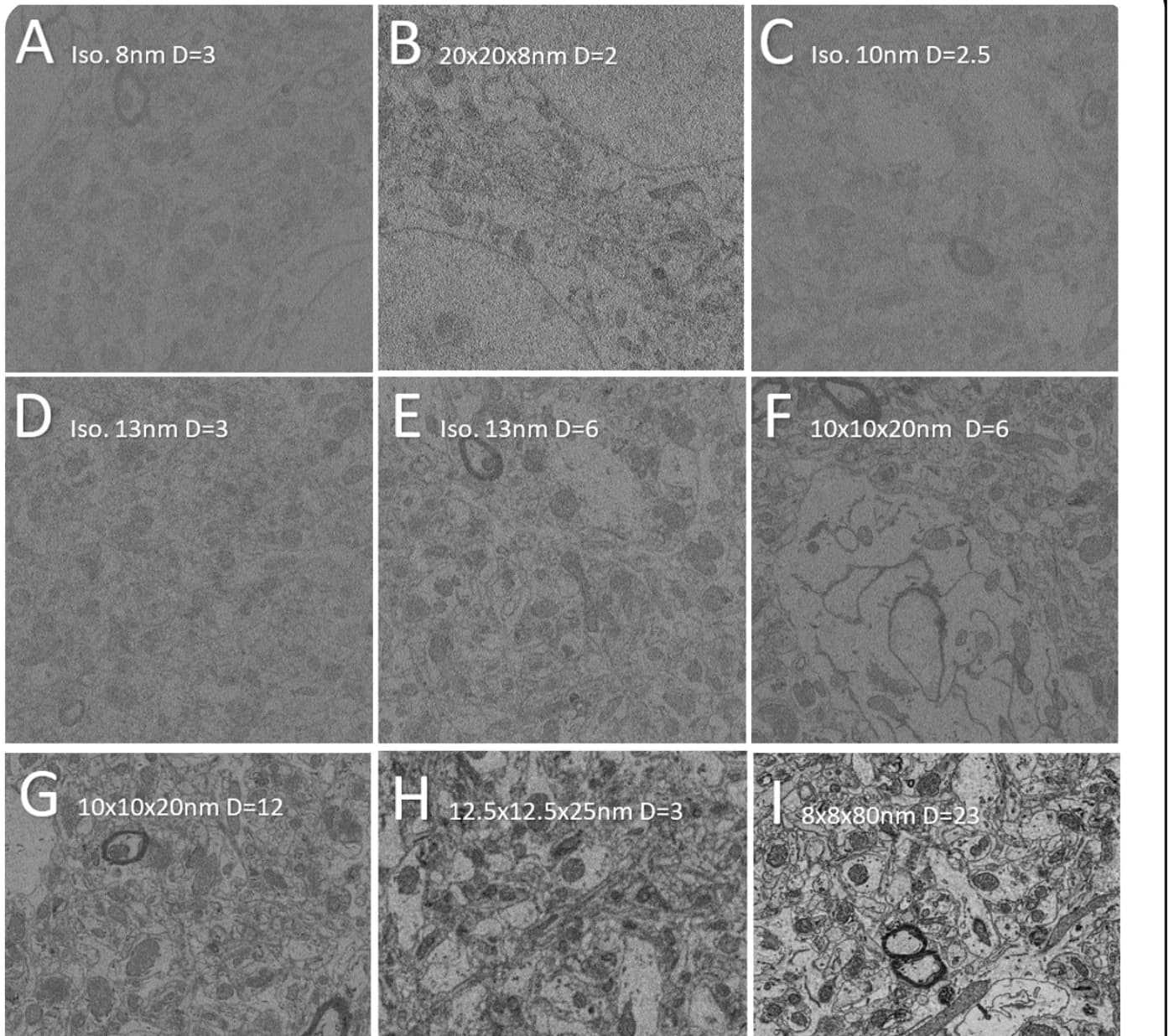
Figure 2. Representative sections from each acquisition (A–I), labelled by voxel geometry and dose (D, e/nm²). Higher dose/anisotropy (F–I) render structure crisply; low-dose isotropic stacks (A, C) are noise-limited. Kensho BSE detector.
Image quality versus dose
Effective lateral resolution is set by the dose deposited per unit area rather than by the z-step itself. Plotting SNR and indicative lateral resolution against dose across all nine acquisitions shows a clear, predictable trend: resolution improves with dose, while coarse-pixel, low-dose acquisition (B) reaches high SNR most efficiently.
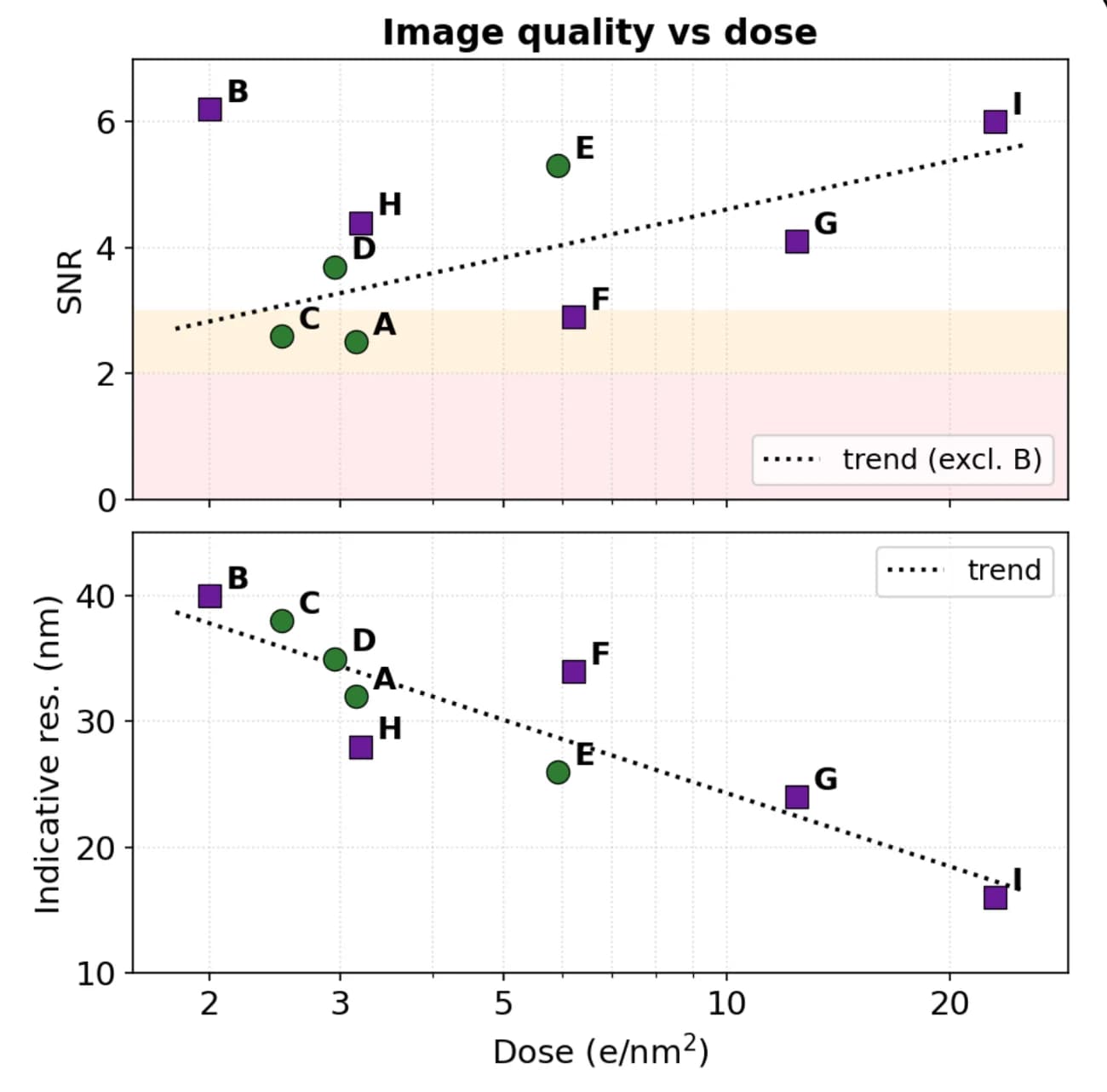
Figure 3. Image quality versus dose across the nine acquisitions (top: SNR; bottom: indicative lateral resolution; dotted lines, trends vs log dose). Resolution improves with dose, while coarse-pixel, low-dose acquisition (B) reaches high SNR most efficiently. See the full paper for details.
Conclusions
The Katana microtome delivers reproducible ultrathin sectioning across the entire SBF-SEM range (8–80 nm): structural cutting variation stays below 3% up to a 25 nm z-step — and below 0.5% at optimal settings — with the 1 nm z-stage holding section thickness uniform independent of z-step or line accumulation. Paired with the Kensho BSE detector, it yields quantifiably high-quality volumes at practical doses, with effective lateral resolution down to ~24 nm — a validated, flexible platform for volume EM.
Ultimately, the best combination of settings is dictated by the biological question rather than by any single optimum. To resolve fine lateral detail (cristae, synaptic vesicles, and other sub-30 nm features) the practical route is to raise the dose and accept a coarser z-step, since lateral resolution must be bought with signal. Where isotropic voxels are needed the constraints are tighter: the smaller the isotropic voxel, the more it is under-resolved laterally relative to its own sampling. A ~25 nm z-step is a good compromise, matching the indicative lateral resolution (~28 nm) to the section thickness for genuinely balanced resolution, whereas a 13 nm isotropic voxel offers the thinnest practical sections that still receive enough dose to carry discernible information in every voxel; finer isotropic voxels fall below that threshold and become noise-limited.
Katana microtome — Technical Specifications
- Section thickness 8–200 nm; the 1 nm z-stage enables reliable ultrathin sectioning below 30 nm (this study). Cutting speed 0.05–5 mm/s.
- Z travel 1.3 mm with <1.5 nm standard deviation; sample volumes up to 1.2 mm³.
- 1.5–2.5 mm Diatome diamond blade at 45° sample incidence.
- Knife oscillation amplitude up to 200 nm, tuneable to 100 kHz.
- Compatible with TESCAN, JEOL, Hitachi, ThermoFisher and Zeiss SEMs with multi-ROI and montaging.
- Dimensions 135 × 66 × 56 (H) mm; minimum working distance 3.0 mm.
Download the full application note (PDF)
For more information on the Katana microtome and Kensho BSE detector, visit connectomx.com or contact us at [email protected].